Flash floods are among the deadliest hydrometeorological hazards in the United States, and many are associated with heavy rainfall produced by mesoscale convective systems (MCSs). Understanding these events requires connecting how storms evolve and produce rainfall with how watersheds respond.
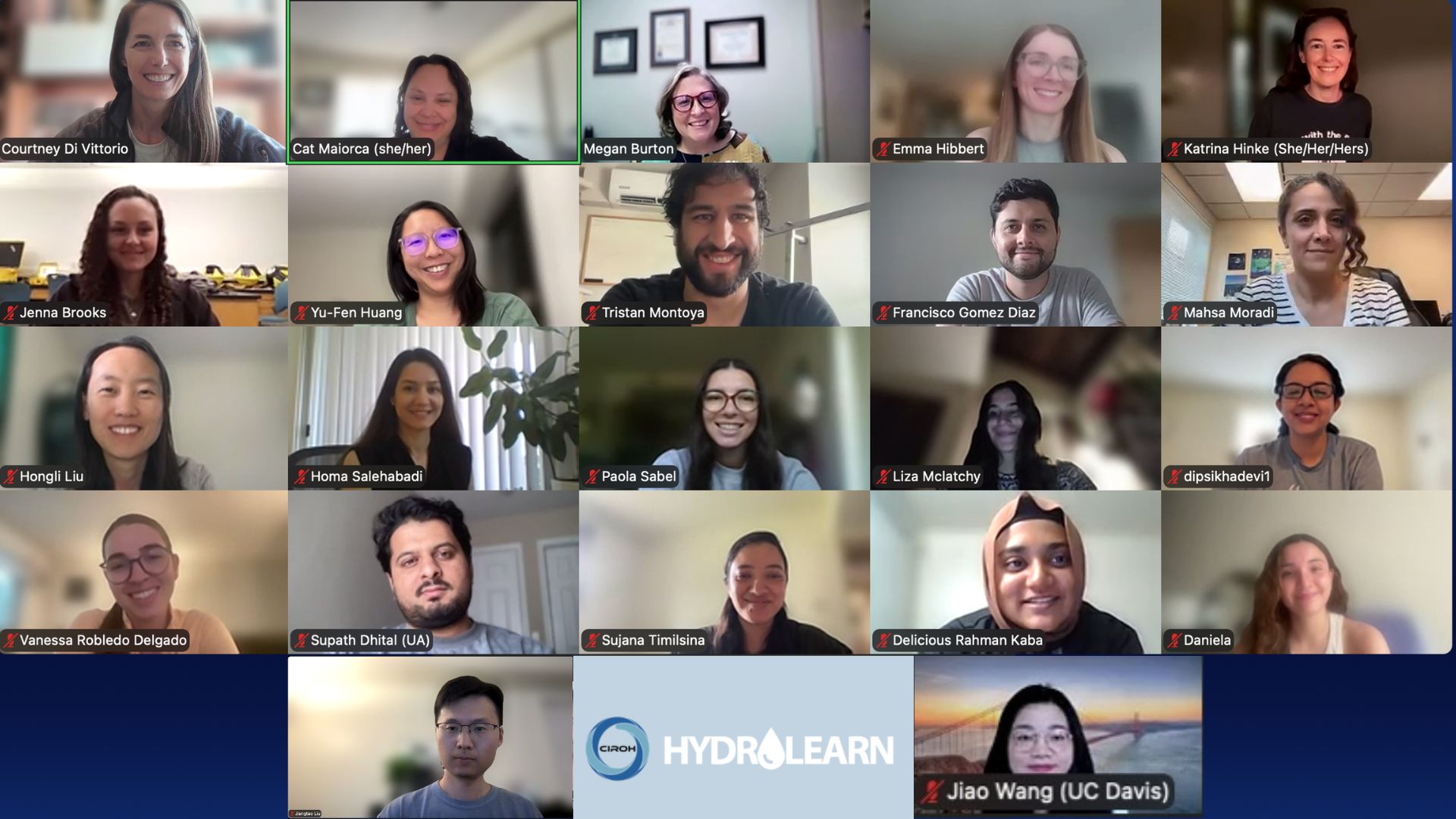
AHWA Lab PhD candidate Vanessa Robledo was selected to participate in the CIROH HydroLearn 2026 Workshop and Hackathon, a program focused on developing active-learning educational resources for hydrology and water science.
The program included an in-person workshop held during the CIROH Developers Conference in Salt Lake City in May 2026, followed by a virtual hackathon and a peer-review process focused on assessment-driven course design.
As part of the program, Robledo worked with Delicious Rahman Kaba and Mohamed Abdelkader, with guidance from Humberto Vergara, to develop a new HydroLearn module titled “Understanding Flash Floods Through Storm Tracking.”
The new module uses a real flash flood event in Iowa to introduce learners to this connection. Students follow the evolution of an MCS using satellite observations, characterize the associated precipitation, identify the hydrologic response in streamflow observations, and ultimately reconstruct the evolution of the flash flood event.
A key component of the module is its hands-on approach. Through HydroShare computational resources, learners work directly with Earth observation and hydrologic datasets to run ATRACKCS, an object-based storm-tracking algorithm and perform flash-flood identification. These activities allow students to move from learning the underlying concepts to applying tools and data used in hydrometeorological research.
The team gratefully acknowledges Courtney Di Vittorio, Megan Burton, and the CIROH HydroLearn team for their guidance throughout the workshop, hackathon, and peer-review process.
Explore the module here: Understanding Flash Floods Through Storm Tracking